
Phuket’s Nightlife Expansion: Who Wants It, Who Pays, and What Happens Next
Provincial authorities are weighing a significant expansion of Phuket’s nightlife district, and the conversation has moved beyond tourist operators and noise complaints into harder territory: licensing, enforcement, public safety, and whether the island’s existing infrastructure can absorb what comes with it.
The proposal remains fluid, and details are still being negotiated between municipal offices, provincial licensing authorities, and tourism stakeholders. But the direction is clear. Officials want to broaden the zones where late-night venues can operate, extend permissible hours in select areas, and bring more establishments under formal licensing frameworks. The stated aim is to capture more tourism revenue, formalise businesses currently operating in grey zones, and position Phuket more competitively against regional rivals like Bali and Bangkok.
What is less clear is how the expansion will be enforced, who absorbs the cost of managing it, and whether residents in affected neighbourhoods will have meaningful input before the changes take effect.

Why Now, and Why Officials Are Pushing
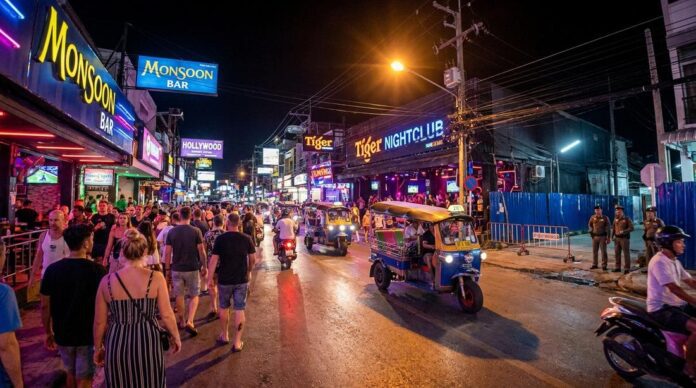
The timing is economic. High season arrivals are strong this year, but average spend per visitor has flattened. Officials believe that expanding nightlife infrastructure will keep tourists on the island longer, encourage them to spend more after dark, and create jobs in hospitality, transport, and entertainment. There is also pressure to formalise venues that have operated without proper licensing, especially in areas like Patong, Kata, and parts of Phuket Town where enforcement has been inconsistent.
The expansion is also a response to competition. Thailand’s tourism policy has shifted toward higher-value experiences, and nightlife is part of that mix. Officials see it as a lever they can pull without waiting for new hotel approvals or airport capacity upgrades.
Officials see nightlife as a lever they can pull without waiting for new hotel approvals or airport capacity upgrades.
What Could Change on the Ground
The core of the proposal involves rezoning certain residential and mixed-use areas to permit late-night establishments, extending closing hours from 2:00 am to 4:00 am in designated zones, and issuing new licences for bars, clubs, and entertainment venues that currently operate informally or under temporary permits.
Transport is a significant component. If hours are extended, local authorities will need to coordinate late-night taxi services, ride-hailing coverage, and potentially shuttle systems to reduce drink-driving incidents. Enforcement of drink-driving laws has improved in recent years, but the infrastructure to support safe late-night movement is still patchy, especially outside Patong.
Noise controls are another open question. Existing regulations are rarely enforced consistently. If the expansion proceeds, residents in newly zoned areas will expect clear decibel limits, regular monitoring, and penalties that actually stick. Without that, the policy risks creating conflict between operators who invest in new licences and residents who were never consulted.
Without clear decibel limits and enforcement, the policy risks creating conflict between operators and residents who were never consulted.
Who Stands to Gain
Tourism operators are the obvious beneficiaries. Bar owners, club operators, and entertainment venues see the expansion as an opportunity to formalise their businesses, access better financing, and operate with less regulatory uncertainty. Larger hospitality groups with mixed-use developments stand to gain if their properties can incorporate licensed nightlife venues.
Employment will likely increase, particularly for Thai nationals in service roles. Phuket’s workforce has tightened during high season in recent years, and new venues will need bartenders, security, cleaners, and managers. Whether those jobs translate into stable, well-paid employment depends on enforcement of labour standards, which has historically been weak in the nightlife sector.
Who Stands to Lose
Residents in areas that shift from quiet mixed-use to late-night zones will see immediate quality-of-life impacts. Noise, traffic, and waste collection all become more difficult to manage when venues operate until 4:00 am. Property values in those neighbourhoods could decline if the expansion is poorly managed.
Small business owners who operate restaurants, cafés, and shops in affected areas may find themselves competing for parking, dealing with increased foot traffic they cannot monetise, and navigating a neighbourhood character that no longer aligns with their customer base.
Health and fire safety enforcement is another gap. Phuket’s nightlife sector has a mixed record on building codes, emergency exits, and overcrowding. If new licences are issued without rigorous inspections and follow-up, the risk of serious incidents increases. The island’s emergency services are already stretched during high season.
The Regulatory and Safety Questions
Licensing authority will likely sit with provincial offices, but enforcement will fall to municipal police, health inspectors, and fire-safety teams. Those agencies are already under-resourced, and adding oversight of dozens of new venues will require budget increases, staff training, and clearer chains of accountability.
Public safety depends on coordination that does not yet exist. If closing hours extend to 4:00 am, police patrols need to align with those hours. Emergency medical services need to be staffed accordingly. Waste collection schedules need to shift. None of that happens automatically, and the cost will be borne by municipal budgets that are already tight.
Environmental and health advocates are raising concerns about wastewater, waste management, and the cumulative impact of late-night activity on coastal areas. Patong’s drainage system struggles during heavy rain now. Adding more high-density venues without corresponding infrastructure investment could make flooding and sanitation problems worse.
What Happens Next
The proposal is still working its way through stakeholder consultations. Provincial officials have not announced a formal timeline for approval, but momentum is building. If licensing frameworks are finalised this quarter, initial permits could be issued before the next high season.
The approval path will require sign-off from municipal councils, provincial licensing boards, and likely coordination with national tourism and interior ministries. Legal challenges are possible, particularly if resident associations push back on zoning changes or if environmental groups argue that impact assessments were inadequate.
Key hurdles include finalising noise limits that can actually be enforced, establishing transport coordination between venues and public-safety agencies, and ensuring that fire and health inspections are completed before any new licences take effect. If any of those steps are skipped or rushed, the policy could face immediate operational problems.
What It Means for Phuket
Nightlife expansion is not inherently a problem. Done well, it can create jobs, formalise businesses, and make Phuket more competitive. Done poorly, it shifts costs and disruption onto residents and small businesses while concentrating benefits among a few large operators.
The difference will be in the details: enforceable standards, transparent consultation, and infrastructure investment that matches the scale of the change. Those pieces are not yet in place, and whether they will be depends on decisions being made in provincial offices right now.