
Phuket Nightlife Expansion: Who Benefits When the Party Gets Bigger?
Local authorities are floating a significant expansion of Phuket’s nightlife district, and the question isn’t whether it will reshape parts of the island. It will.
The question is who pays the cost, who collects the upside, and whether enforcement can keep pace with ambition.

What’s Actually on the Table
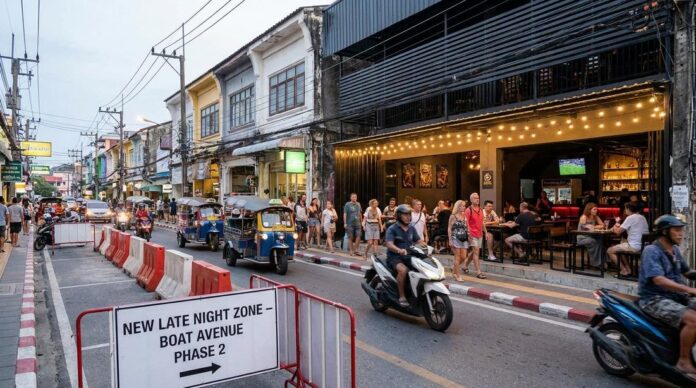
The proposal centres on extending licensed entertainment zones beyond their current boundaries, with changes to operating hours, venue licensing criteria, and transport infrastructure to accommodate late-night movement. Specifics remain fluid as the plan moves through approval channels, but the intent is clear: make more room for more venues in areas that have historically sat just outside the official nightlife perimeter.
Officials frame the push as economic pragmatism.
Tourist spending on entertainment, dining, and alcohol continues to drive a disproportionate share of island revenue. Expanding the zones where that spending can legally occur, they argue, captures demand that currently leaks offshore or into grey-market venues operating without proper oversight.
The economic logic is straightforward. More licensed venues mean more declared revenue, more formal employment, and theoretically, more tax collection. For operators who’ve long felt constrained by zoning rules that favour legacy districts like Patong, the expansion offers a chance to build or retrofit properties in neighbourhoods where land costs less and the clientele skews slightly older and wealthier.
The Residents Who Didn’t Ask for This
Economic upside rarely distributes evenly, and nightlife expansion tends to fall hardest on the people who live adjacent to it.
Noise is the most obvious friction point. Even well-designed venues leak sound, and enforcement of decibel limits on Phuket has historically been inconsistent. Residents in quieter pockets of Kathu, parts of Cherngtalay, and residential stretches near Chalong have watched property values climb on the promise of tranquillity. An influx of late-night venues changes that calculus overnight.
Traffic compounds the problem. Phuket’s road network wasn’t built for the volume it already carries during high season. Adding concentrated nightlife nodes without corresponding upgrades to public transport or taxi regulation risks gridlock that radiates well beyond the entertainment zone itself.
Small businesses caught in the expansion zone face a different pressure.
A neighbourhood café or family-run restaurant operates on thin margins and depends on daytime foot traffic. When the street outside becomes a late-night corridor, rents adjust to reflect the new tenant profile. Landlords begin favouring operators who can afford to pay for prime evening hours, and legacy tenants get priced out or forced to pivot.
Licensing, Enforcement, and the Gap Between Policy and Practice
The success of any nightlife expansion hinges on regulatory follow-through, and Phuket’s track record here is mixed.
Licensing frameworks exist. Health inspections, fire safety codes, alcohol service rules, noise ordinances,all are codified. The question is capacity. Does the provincial administration have the staff, the budget, and the political will to enforce standards across a broader footprint? And what happens when a venue opens faster than inspectors can certify it?
Policing presents a parallel challenge. Late-night entertainment districts require visible, consistent law enforcement to manage public safety, prevent exploitation, and deter the informal economy that tends to cluster around nightlife. Stretched thin across an island that already sees significant seasonal population swings, local police would need additional resources to maintain order in newly designated zones.
Fire safety and emergency access are less visible but equally critical. Many of Phuket’s older commercial buildings were not designed for high-density nighttime use. Retrofitting to meet modern safety standards is expensive, and shortcuts are common when oversight is light.
If enforcement lags, the expansion risks creating a patchwork of compliant and non-compliant venues, with the latter undercutting the former on price and pushing the entire district toward a regulatory race to the bottom.
Who’s at the Table, and Who Isn’t
Tourism operators and hospitality groups have the most to gain, and they’ve been vocal in support. Larger chains see an opportunity to replicate successful entertainment models from Bangkok or international markets. Independent operators view expanded zoning as a rare chance to enter a market that’s been geographically locked for years.
Resident associations, by contrast, tend to lack the organisational cohesion or political access of commercial lobbies. Their concerns surface in local forums and social media but rarely carry the same weight in provincial planning sessions.
Public health advocates have raised questions about alcohol availability and its knock-on effects, particularly in communities where underage drinking and drink-driving already strain medical and emergency services. Environmental groups point to waste management and water use, both of which spike in entertainment districts and both of which Phuket struggles to manage at current levels.
What’s missing from most public discussion is a clear forum where these groups can negotiate tradeoffs in real time, rather than reacting after zones have been drawn and licences issued.
Timeline and What Could Still Change It
The approval path runs through municipal endorsement, provincial sign-off, and likely some level of national tourism-authority blessing. That process typically spans months, not weeks, and it’s vulnerable to delay whenever public opposition gains traction or a high-profile safety incident shifts the political mood.
Legal challenges are possible, particularly if rezoning decisions bypass environmental impact assessments or fail to provide adequate notice to affected residents. Permit bottlenecks at the district level could slow individual venue openings even if the broader policy moves forward.
Election cycles matter, too. Local officials championing the expansion need to weigh short-term economic wins against the risk of voter backlash if implementation goes poorly.
What Happens Next
Phuket nightlife expansion isn’t inherently good or bad. It’s a policy bet that the island can absorb more late-night activity without sacrificing liveability for the people who call it home year-round.
That bet depends entirely on execution. Done well, with serious investment in enforcement, transport, and resident protections, it could broaden Phuket’s appeal beyond the aging Patong model and create employment in neighbourhoods that need it. Done poorly, it accelerates gentrification, strains infrastructure, and turns residential pockets into noise zones that benefit a narrow slice of commercial operators.
The debate shouldn’t be whether Phuket grows its nightlife economy. It will. The debate should be whether growth happens with enough planning, transparency, and enforcement to make it sustainable for everyone who lives with the result.