
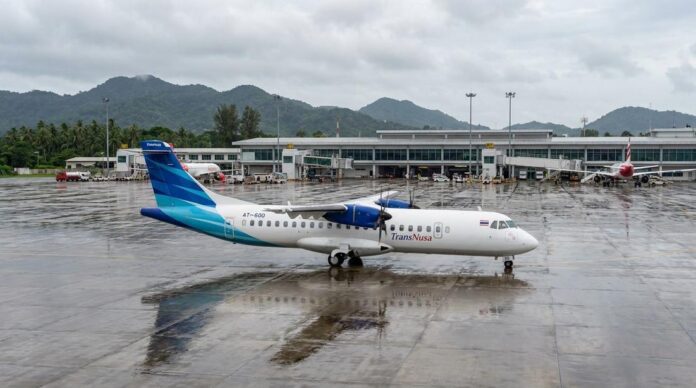

TransNusa Plans Bali–Phuket Direct Route for September 2026
Indonesian carrier TransNusa is reportedly planning to launch direct flights between Bali and Phuket starting September 2026, a move that would create the first consistent point-to-point connection between two of Southeast Asia’s most visited leisure destinations.
Right now, travelling between Denpasar and Phuket means a stop in Bangkok, Kuala Lumpur, or Singapore. Flight time stretches to six or seven hours with layovers factored in. A direct service cuts that to under three hours and opens up itineraries that combine Indonesian and Thai resort stays without the friction of connections.
Multi-destination travel already drives a significant share of arrivals into Phuket during high season. Adding Bali to that circuit makes sense for villa operators, yacht charter companies, and tour operators building packages around island-hopping in both directions. September timing would position the route to capture momentum just ahead of Thailand’s traditional high season and as Bali exits its driest months.

The reported plan has not yet been confirmed by TransNusa or civil aviation authorities in either country, and no details on aircraft type, frequency, or pricing have been disclosed.
What matters now is the commercial logic underpinning the route and what stakeholders on both sides should be watching.
Route Viability Depends on More Than Distance
Direct flights work when there is enough year-round demand to fill seats at yields that cover costs. Bali and Phuket share similar visitor profiles,high-net-worth leisure travellers, long-stay guests, wellness and diving tourism,but peak seasons do not perfectly overlap. Phuket’s high season runs November through April. Bali sees its strongest arrivals between May and September.
A September launch would catch the tail of Bali’s peak and the lead-up to Phuket’s, but load factors in the shoulder months will determine whether the route survives its first year.
Aircraft selection will shape frequency and pricing. TransNusa operates a mixed fleet that includes ATR turboprops and narrowbody jets. A turboprop configuration limits range and capacity but offers lower operating costs on thinner routes. Jets allow higher frequencies and premium pricing but require stronger forward bookings to justify deployment. Neither option has been confirmed.
Distribution partnerships will matter as much as schedule. If the route is loaded into global distribution systems and picked up by major online travel agencies early, it stands a better chance of gaining traction with international travellers booking multi-country trips. If it relies on direct sales and tour operator allocation alone, reach will be limited.
Regulatory Steps Still Ahead
International air services require bilateral traffic rights, slot access at both airports, and commercial operating permits from civil aviation authorities. Indonesia and Thailand maintain an open-skies framework under ASEAN agreements, which simplifies some approvals but does not eliminate the need for formal filings and slot coordination. Phuket International Airport handles significant seasonal congestion during high season, and new entrants typically face tighter slot windows than incumbent carriers.
These logistics take months to finalise and represent fixed costs that must be absorbed whether the route performs or not.
TransNusa would also need to secure handling agreements, fuel contracts, and ground service partnerships at Phuket, none of which are trivial for a carrier without an existing Thai network.
Until regulatory filings appear and the airline issues a public schedule, the September 2026 date remains a reported target rather than a confirmed launch.
What Hoteliers and Operators Should Do Now
Waiting for formal confirmation is a mistake. If the route does launch as reported, properties and tour operators that build Indonesia–Thailand packages early will capture the first wave of demand. That means opening conversations with distribution partners in both markets, adjusting pricing for multi-destination stays, and preparing collateral that positions Phuket as a natural extension of a Bali trip or vice versa.
Yacht charter operators should be particularly attentive. Denpasar is a gateway to Komodo, Flores, and Raja Ampat,destinations with strong overlap in clientele with Phuket’s superyacht and liveaboard diving market. A direct link makes it easier to position Thailand and Indonesia as a single season rather than two separate trips.
Hotel revenue managers should also model what inbound Indonesian leisure demand might look like. Indonesia is already among Phuket’s top ten source markets, but most arrivals come via Bangkok or Kuala Lumpur. A direct service could shift booking windows, average length of stay, and rate sensitivity in ways that warrant adjusting yield strategies now rather than reacting once the flights are live.
Indonesia–Thailand Connectivity Has Been Underserved
Bali Phuket direct flights would address a gap that has existed for years. Despite strong cultural and economic ties between Indonesia and Thailand, air connectivity between leisure hubs outside of Jakarta and Bangkok remains thin. Charter services have appeared sporadically, but no carrier has sustained a scheduled point-to-point link between Denpasar and Phuket.
That underservice reflects the reality that leisure routes are harder to sustain than business routes. Demand fluctuates with currency moves, visa policies, and economic cycles in source markets. Frequencies need to match hotel booking windows, and pricing needs to stay competitive with one-stop alternatives that benefit from connecting traffic.
TransNusa would be betting that pent-up demand and improved distribution technology have shifted the equation enough to make the route work.
If the bet pays off, it creates a template for other underserved leisure pairs across Southeast Asia. If it does not, it reinforces why incumbents have avoided the route.
Stakeholders in Phuket should treat this as material intelligence and plan accordingly, but without assuming certainty until the schedule is live and tickets are on sale.


